
How Bench Warrants Work in Smith County
A bench warrant is a court order tied to a case already before a judge. Smith County sources identify failures to appear, missed criminal settings, and bond-forfeiture proceedings as routes to warrant action. In traffic and fine-only cases, the record may instead use FTA or capias pro fine language. The exact label depends on the court and obligation.
Do not assume a missed date automatically produced a warrant, or that an online docket has the latest entry. The court that scheduled the matter can tell whether it was reset, a bond was forfeited, or a warrant was issued.
Smith County JP Bench Warrants After Missed Court
Smith County's Traffic Cases page describes a local sequence involving a missed appearance, possible warrant action, payment or bond choices, and a separate OMNI license-renewal report. These are related steps, not one automatic status. Start with the precinct shown on the ticket and ask whether the court's record says FTA, warrant, capias pro fine, or a new setting. Do not use a neighboring precinct's instructions.
The JP directory lists five precincts and their own contacts. The county does not publish one universal fee, reinstatement amount, or bond schedule for every traffic warrant.
Bench Warrant Issuance in Smith County
When a required appearance is missed, the judge may review the case record and issue an order directing the person's arrest or requiring a court response. The order belongs to the court handling the underlying case. A District Court felony matter routes through the District Clerk; county misdemeanor records use the County Clerk's criminal department; JP and city cases stay with those courts.
Smith County has no single public statewide warrant-search database. TCIC, TLETS, and NCIC are restricted law-enforcement systems, and DPS's public FTA/FTP program addresses license-renewal holds rather than confirming an arrest warrant. Ask the issuing court what has been recorded and what proof follows a resolution.
Smith County Criminal Bond-Forfeiture Proceedings
Smith County's County Court at Law 2 and 3 materials warn that missing a criminal setting can result in bond forfeiture and a warrant. Bond forfeiture concerns the bond obligation; it is not the same as an unpaid traffic fine. The court's assigned clerk or coordinator can identify the docket entry and explain how to request a new setting or present a motion. The County Court at Law 3 criminal docket page is the official source shown in the image.
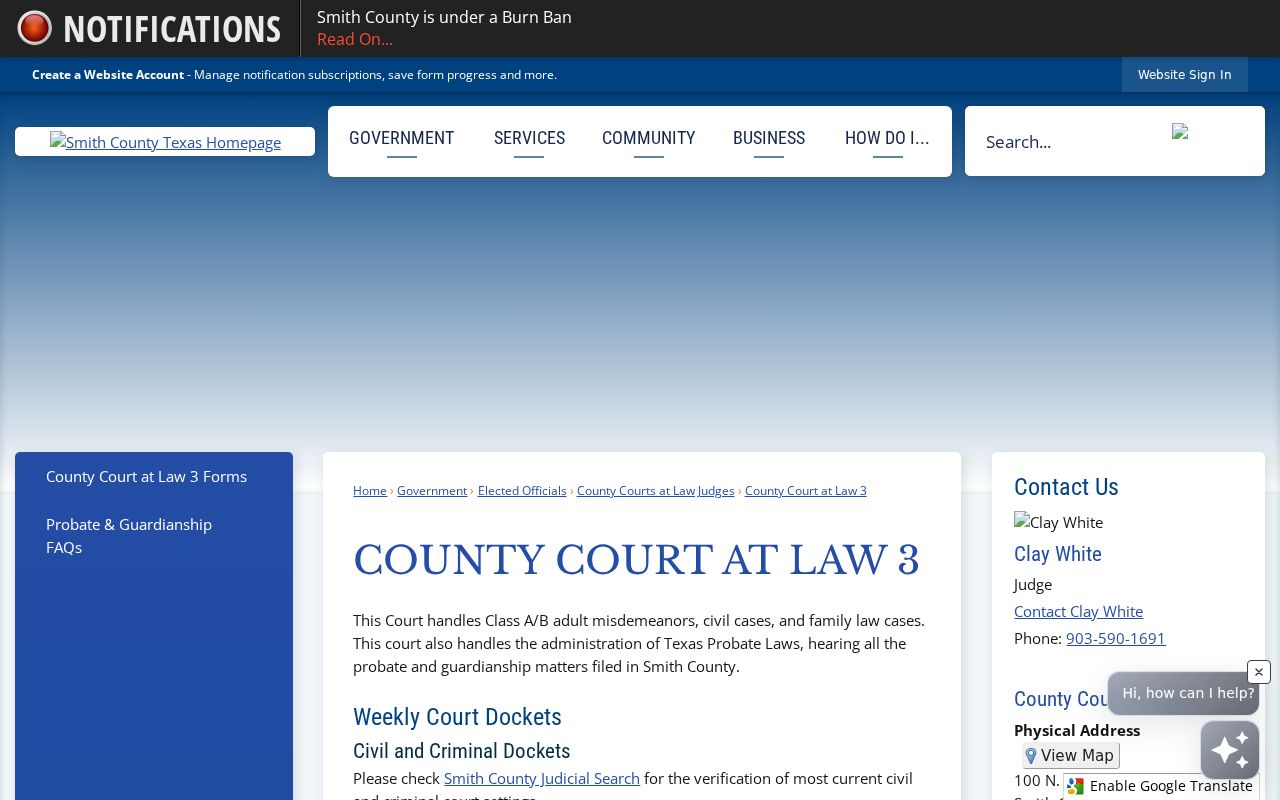
The docket page supplies court scheduling context; ask its clerk or coordinator about a specific case entry.
The research does not establish a countywide grace period, notice mailing rule, or standard recall fee. Read the court's current notice and ask about the specific case instead of relying on another court's practice.
How Bench and Arrest Warrants Differ
A bench warrant responds to a court obligation in an existing case; an arrest warrant authorizes custody after probable-cause review of an alleged offense. Both can result in arrest, but their triggers and records differ. An indictment may also lead to a capias, which is not simply the same document as a missed-setting warrant. The issuing court can identify what the order commands.
| Feature | Bench Warrant | Arrest Warrant |
|---|---|---|
| Trigger | Missed setting or other court obligation | Probable cause tied to an alleged offense |
| Who Issues It | Judge handling the existing case | Judge or magistrate on a complaint or affidavit |
| Underlying Case | Already filed matter | Investigation or charge process |
| How It Clears | Court appearance, recall, or quash order | Court-directed surrender, bond, or other order |
Smith County Capias Pro Fine Is a Separate Record
Texas Chapter 45A governs specified municipal and JP procedures, including capias pro fine after an unpaid judgment. That writ concerns fine or cost enforcement and should not be casually labeled a new charge. The county's official traffic page explains payment and bond routes for JP cases; the exact route depends on the court and current judgment.
The image below links to the statutory page and shows its legal source, not a local list of active cases.
Read Texas Code of Criminal Procedure Chapter 45A.
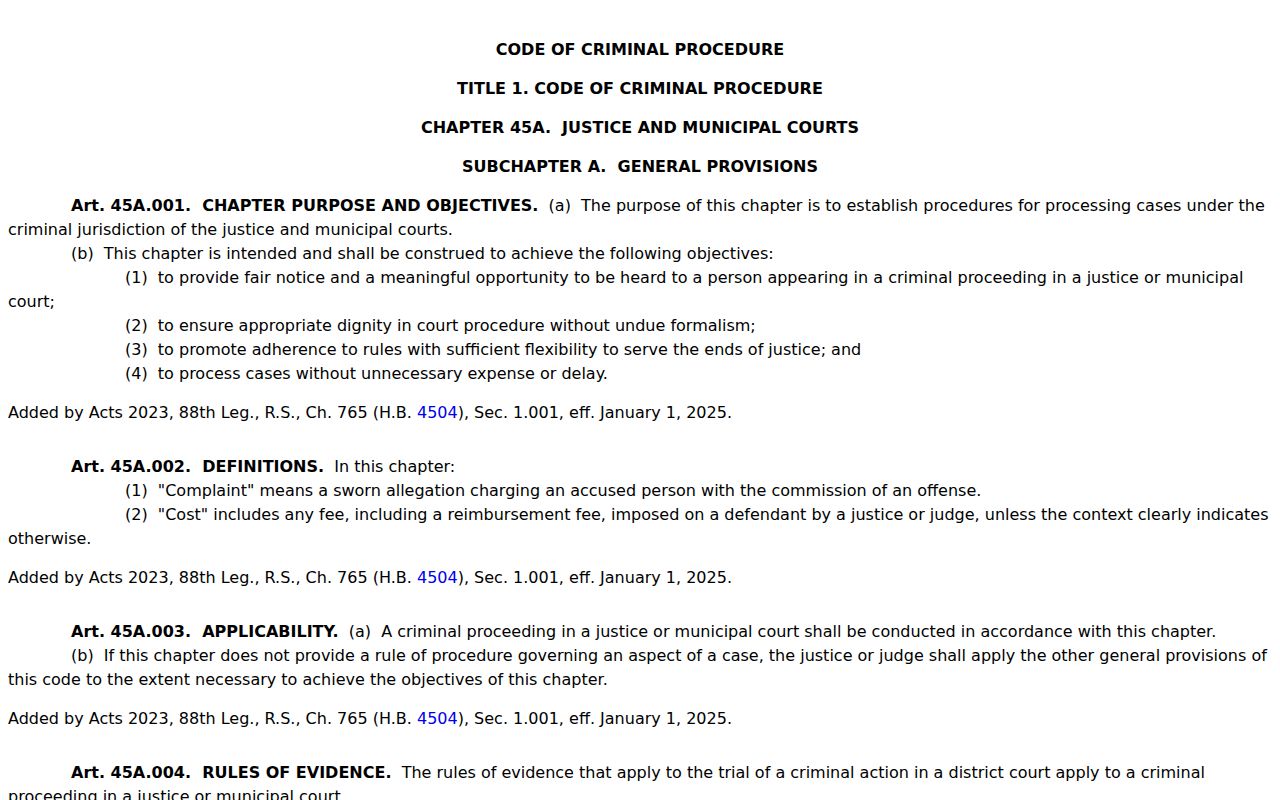
For an individual matter, the JP or municipal clerk can say whether the judgment, capias, payment, or appearance requirement remains open.
Clearing a Bench Warrant in Smith County
Resolution begins with confirming which court issued the order and whether the case needs a setting, bond, payment, or motion. The county has not published a universal walk-in recall docket or surrender schedule. An attorney can contact the court and help select the appropriate path; a clerk can explain filing logistics but cannot promise a judge will grant relief.
- Use the cause or citation number to confirm the case and court.
- Ask whether the record is a bench warrant, capias, capias pro fine, or bond forfeiture.
- Have counsel discuss a motion, appearance, bond, payment, or new setting with the court.
- Get a receipt or written court confirmation and ask when linked systems should update.
Caution: Do not assume an old or missing online entry has expired; confirm the court's current status before appearing or making payment.
Smith County Bench Warrant Rules Differ in City Courts
Lindale says the relevant citation process requires an appearance within ten business days and that a phone call is not an appearance. Bullard's FAQ says an FTA results in an FTA charge and warrant; its displayed fee should be confirmed because amounts can change. Whitehouse's citation-options document says a warrant affects defensive-driving eligibility. These are city rules, not countywide bench-warrant terms.
Use the citation's issuing court before applying another city's instructions to a county case.
Troup City Court and JP 3 Keep Separate Files
Troup City Hall lists the municipal-court contact at 106 E. Duval Street, while Smith County JP Precinct 3 is at 313 E. Duval Street and lists 903-590-4729. The offices are close, but they handle different proceedings. A missed Troup municipal date must be checked with the city court; a county citation belongs with the JP precinct shown on its paperwork.
Read the court name and cause number before calling. One clerk cannot confirm whether the neighboring court recalled its separate bench warrant.
Smith County Courts That Issue Bench Warrants
The issuing court controls its case and any recall order. Smith County has five JP precincts, three County Courts at Law, five District Courts, and municipal courts in its cities. The District Clerk and County Clerk maintain different records, while city citations stay with their municipal court. The sheriff may serve process but does not decide whether a judge should recall it.
Check the case paperwork or county directory, then contact the named clerk or coordinator. For the full county route, begin at Smith County warrant records.